Field report 05 · 11 min · The map · Three elevations
High-grown, mid-grown, low-grown: a reading of three elevations.
A reading of the three Ceylon teas — from the Nuwara Eliya plateau at nineteen hundred metres, down through the Kandy mid-country, to the Ratnapura lowlands below five hundred.

Hatton · November 2025
The Ceylon tea trade, by a convention established at the Colombo auction in the 1890s and codified by the Tea Research Institute in the 1930s, divides the country into three elevation classes. High-grown is above twelve hundred metres. Mid-grown is between six hundred and twelve hundred. Low-grown is below six hundred. The three classes are not abstract. They name three distinct teas, produced from the same plant on the same island, that taste different, sell to different markets, and earn different prices. The country is, in the auction catalogue, three countries.
High-grown — above 1,200 metres
The high-grown country is the Central Province highlands. The principal districts are Dimbula on the western slope, Uva on the eastern, Nuwara Eliya at the top of the plateau, Dickoya in the southern Hatton basin, and Uda Pussellawa on the cooler edge of the eastern slope. The growing elevations are between twelve hundred and a fraction above two thousand metres — Nuwara Eliya, at one thousand eight hundred and ninety metres, is the highest commercial tea-growing zone in Ceylon and one of the highest in the world.
The high-grown tea is what the international market means by "Ceylon tea". It is the light, bright, aromatic, briskly astringent black tea that fills the breakfast pots of the Russian, Iranian, Turkish, and Middle Eastern markets, and that constitutes the principal value of the country's tea exports. The two seasons of quality — the western Dimbula in January to March, the Uva in July and August — produce, in a good year, teas that command, at the Colombo auction, two to three times the average per-kilogram price of the country's mid- and low-grown teas.
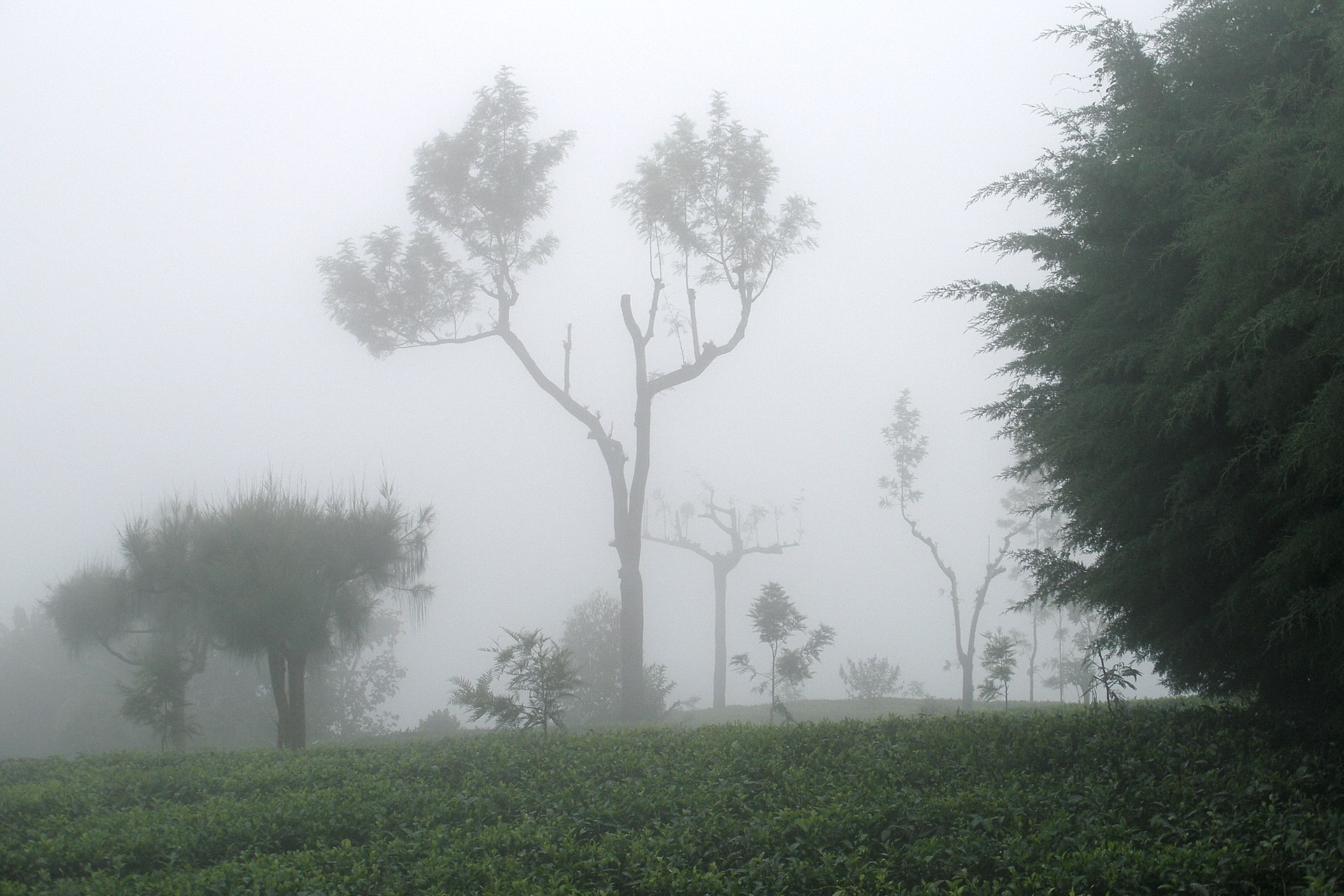
The high-grown landscape is unmistakable. The bushes are planted in close contour-line rows across steep slopes, with the silver oak shade trees (Grevillea robusta) scattered at a density of about thirty per hectare. The estates have the bungalows on the highest accessible point, the lines lower down the slope, the factory at the valley bottom. The Indian Tamil labour, descendants of the workers brought from Madras Presidency in the 1840s and 1850s, lives in the lines. The estate roads, the railway, the small commercial towns of Hatton and Talawakelle and Nanu Oya, are organised around the rhythm of the plucking and the factory shift.
Mid-grown — 600 to 1,200 metres
The mid-grown country is the Kandyan highlands proper, in a band that runs from Kandy itself south-westwards through Gampola, Pussellawa, and Hewaheta. It includes some of the oldest tea plantings in the country — Loolecondera, where James Taylor began his experiment in 1867, is at one thousand one hundred metres and is in the upper mid-grown zone — and it includes a significant smallholder sector that has grown up around the older estates.
The mid-grown tea is a fuller, darker, more body-heavy tea than the high-grown. It has less of the bright aromatic quality of the Dimbula and the Uva, and more of the malty depth that the European packers value as a base for blending. The principal market for the mid-grown is the British, the Australian, and the Western European blending trade — Twinings, Tetley, Ahmad, Bewley's of Dublin — where the tea is used as a workhorse in the breakfast blends.
The mid-grown elevations get more rain than the high-grown, and a longer growing season, and the yields per hectare are correspondingly higher — twenty per cent higher, in a normal year, than the high-grown yields. The price per kilogram is lower; the volume-to-revenue equation is similar.
Low-grown — below 600 metres
The low-grown country is the wet zone of the south-western quarter of the island — the Galle, the Matara, the Ratnapura, the Kalutara, the lower parts of the Sabaragamuwa. It is the country of the village smallholding, of the rubber and the coconut, of the rice paddy in the valley bottom and the small home gardens around the village temple. The tea grown here is, almost without exception, smallholder tea — the four hundred thousand small holdings described in field report 04.
The low-grown tea is the country's principal export by volume. It is a bold, leafy, very strongly oxidised tea that suits the Russian, the Iraqi, the Saudi, the Turkish, and the Iranian markets — markets that brew strong, drink with sugar, and value the visible leaf appearance more than the high-grown teas value. The two principal manufacturing styles of the low-grown are the long-leaf "Pekoe" and the strongly twisted "BOP1" — and within those styles there are sub-grades and house styles that are recognisable, on the auction floor, to a buyer who knows the country.
The low-grown yields are the highest in Ceylon — twenty-five to thirty per cent above the mid-grown, fifty per cent above the high-grown, on a per-hectare basis. The growing season is essentially year-round; the bush flushes continuously; the smallholder picks every seven to ten days. The economics of the low-grown smallholding, though tight, are viable in a way that the high-grown estate economics are not — there is no factory to maintain, no line accommodation to provide, no historic capital structure to service. The labour is family labour.
The market segmentation
The three elevations sell to three substantially different markets. The high-grown is the connoisseur and the Middle Eastern premium trade. The mid-grown is the European blending trade. The low-grown is the bulk Middle Eastern and Russian trade. The packers know which elevation they are buying for which market; the buyers at the auction know which lots they are bidding on; the estates and the bought-leaf factories know which buyers will bid on their lots. The country, on the auction floor, is segmented by destination as much as by origin.
Three teas, three markets, three economic structures, three labour systems, three landscapes, three histories — all of them growing on the same plant, on the same island, between the same two coasts.
What the three elevations tell you
Three things, in my reading.
First, "Ceylon tea" is not one tea. The visitor who tastes a Nuwara Eliya, a Kandy, and a Ratnapura side by side will find three different drinks. The country's tea reputation has been built largely on the high-grown teas, but the country's tea volume is in the low-grown.
Second, the three elevations carry three different social structures. The high-grown is the estate-and-line country of the Indian Tamil labour. The mid-grown is mixed estate-and-smallholder, mostly Sinhalese village now with some Indian Tamil remnant. The low-grown is village-smallholder country, entirely Sinhalese in the south and the Sabaragamuwa, with a small Muslim component in the Galle and the Matara. The three Ceylon teas are produced by three different Sri Lankas.
Third, the historical drift is downhill. The smallholder country, at the bottom of the elevation map, has been the growth sector of the industry for fifty years. The estate country, at the top, has been the contracting sector. The replanting rates, the labour-recruitment rates, the capital-investment rates — all of them, when you read the trade press carefully over the long run, point the same way. The future of Ceylon tea, in volume terms, is below six hundred metres.
That this is not yet what the international image of Ceylon tea looks like is, I suspect, a matter of fifteen or twenty more years.
Researched from the Tea Research Institute Elevation Classification (Revised, 2016), the Sri Lanka Tea Board Production Statistics (1985–2024), and field visits to all six principal tea-growing districts between January 2024 and October 2025. The conclusions are the editor's alone.