Field report 04 · 13 min · 1883–2026 · The auction
Smallholders and the Colombo auction, since 1883.
The world's largest tea auction by volume, the four hundred thousand smallholder growers in the Sabaragamuwa and the low country, and the long quiet displacement of the estate by the village.

Hatton · December 2025
The Colombo public tea auction was first held on the thirtieth of July 1883, at the offices of Somerville & Company in the Fort, the colonial commercial district of Colombo. The first auction listed approximately one thousand pounds of tea, drawn from six estates of the Dimbula and the Uva, and was attended by eight buyers. The auction has been held, almost without interruption, every working week of every year since then. It is now the largest tea auction in the world by volume, listing an average of five and a half million kilograms of tea each Tuesday and Wednesday, drawn from approximately two thousand seven hundred individual sellers — of whom the great majority, in the present century, are no longer estates but smallholder cooperatives and bought-leaf factories serving smallholders.
The auction floor
The auction is now held at the offices of the Colombo Tea Traders' Association on Hospital Street, three streets back from the original Fort site. The floor is a long rectangular room with a raised dais for the broker at one end and tiered benches for the buyers along three sides. The broker reads the catalogue lot by lot — perhaps eight thousand lots over the two days — and the buyers bid by raised hand or by raised pencil. The bidding for a single lot lasts, on average, eleven seconds. The fall of the hammer is a quick double-tap on the dais.
The eight buyers of 1883 have, by 2025, become approximately two hundred. They are a mixture of the international packers (Unilever, Tata, Ahmad, Twinings, the Russian Orimi Trade, the German Teekanne, the Iranian Akbar), the regional re-exporters who fill the Middle Eastern and the Russian markets, and a small group of specialist single-estate buyers who serve the gift and the connoisseur trades. The catalogue is published the preceding Friday; the lots are inspected at the warehouse on Sunday and Monday; the bidding fills two long days and is followed by a third day of settlement and lorry-out.
The estate auction, 1883 to 1972
For its first ninety years, the Colombo auction was an estate auction. The sellers were the proprietary estate companies of the Central Province — most of them registered in London, in Edinburgh, or in Calcutta — and the lots were single-estate, single-grade, single-invoice. A buyer at the auction knew, by the estate's name, the elevation of the planting, the soil, the historical character of the leaf, the consistency of the factory. The Ceylon tea industry was, in those ninety years, one of the most concentrated industries in the British Empire: in 1965, six hundred and forty-seven proprietary estates accounted for approximately ninety-seven per cent of the country's tea production.
The remaining three per cent was a small, marginal smallholder sector concentrated in the low country — in the Galle, the Matara, the Ratnapura — where village growers had planted small plots of tea on the edges of their rubber and coconut land. The smallholder leaf was sold to a handful of village factories which processed it on a fee basis and sold it, at the Colombo auction, under their own factory names.
The 1972 reform
In 1972 the government of Sirimavo Bandaranaike, in the second of her terms as prime minister, passed the Land Reform Law. The Law nationalised, with limited compensation, all private land holdings above fifty acres. The 1975 amendment extended the nationalisation to public companies. By the end of 1975, approximately five hundred and seventy of the country's six hundred and forty-seven proprietary estates had been transferred to two state corporations — the Janatha Estates Development Board and the Sri Lanka State Plantations Corporation — which, between them, ran the bulk of the Ceylon tea industry for the next sixteen years.
The state-corporation period (1975–1991) is the most polarising in the industry's history. The official record is that yields fell, that quality declined, that the country lost market share to East Africa, that the estates were starved of capital, that the labour relations were poor. The opposite case — argued by, among others, the former minister Saumya Munidasa in his 1998 memoir — is that the reforms removed an absentee-landlord rentier system that had captured the country's principal export industry for a century, and that the costs of the transition were the costs of restoring a national patrimony.
What is not disputed is that the reform period coincided with, and probably accelerated, a much longer structural change: the rise of the smallholder.
The smallholder ascendancy
In 1972 the smallholder sector produced about ten thousand tonnes of made tea, or four per cent of the national crop. By 1985 it was thirty-eight thousand tonnes, or fifteen per cent. By 2000 it was a hundred and seventy-eight thousand tonnes, or sixty per cent. By 2024 it was approximately two hundred and ten thousand tonnes, or roughly seventy-five per cent of the national crop.
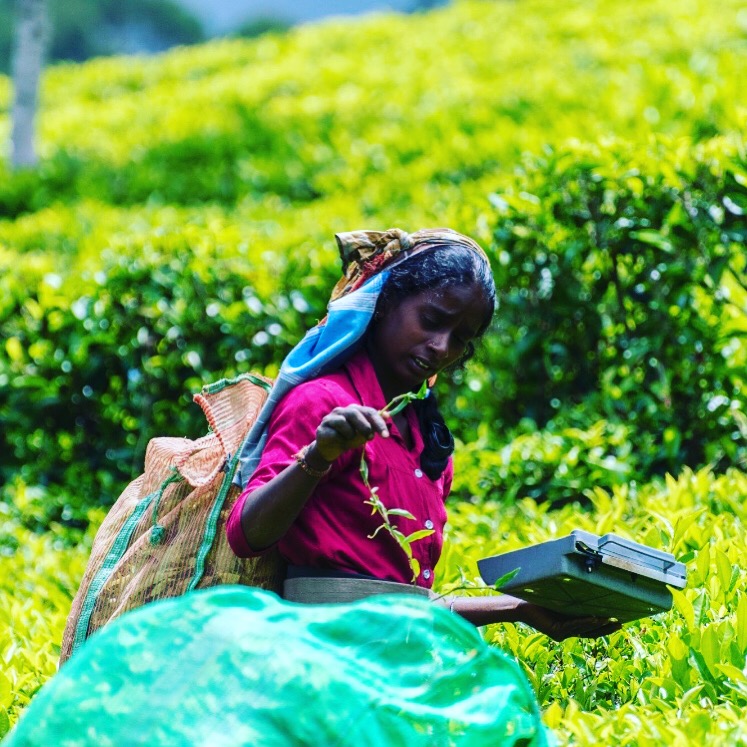
The smallholder of 2024 is a very different actor from the smallholder of 1972. He — and increasingly she — holds, on average, between half a hectare and two hectares of tea, almost always in the mid-country (six hundred to twelve hundred metres) or the low country (below six hundred metres). The holdings are inter-cropped with rubber, coconut, areca, and a small kitchen plot. The tea is harvested by family labour, supplemented at peak times by hired plucking gangs that move between holdings. The green leaf is sold daily to one of approximately seven hundred bought-leaf factories, which process it on the smallholder's behalf and sell the resulting made tea at the Colombo auction.
The four hundred thousand smallholder households of the Sabaragamuwa, the Southern, and the Galle low country are now the demographic core of the Ceylon tea industry. The estate-and-line economy of the high country, with its Indian Tamil labour and its proprietary or state ownership, remains visible — it is what the visitor sees, what the photographs are taken of, what the public imagination still associates with Ceylon tea — but it has been, by volume, the minority sector for a generation.
The auction's adjustment
The Colombo auction has adjusted to the smallholder sector with characteristic conservatism. The catalogue still lists lots by factory name and grade; the bought-leaf factories of the smallholder country are listed alongside the estate factories of the high country; the buyer bids on the lot as it stands. The auction does not distinguish, on the floor, between an estate tea and a smallholder tea. The market does — the prices reflect the perceived quality, the consistency, the elevation — but the institutional form is the same as it was in 1883.
The Colombo auction has, for a hundred and forty-two years, been the principal route to market for the Ceylon tea industry. The form has not changed. The sellers have. The country has.
The smallholder economics
A smallholder of one hectare in the Ratnapura district, on a reasonable bush stand of TRI clones, will produce, in a normal year, between four and five thousand kilograms of green leaf — which is, after manufacture, between nine hundred and a thousand kilograms of made tea. At the 2024 average green-leaf price of approximately a hundred and twenty rupees per kilogram, the gross revenue of the holding is between four hundred and eighty thousand and six hundred thousand rupees a year, before the costs of pruning, fertiliser, and plucking labour. The net is between three hundred thousand and four hundred and twenty thousand rupees — somewhere between the median and the seventy-fifth percentile of rural household income in the wet-zone districts.
The smallholder economics, in other words, are tight. The bought-leaf factory takes its margin, the auction takes its commission, the broker takes his commission, the packer takes the bulk of the value added in branding and blending. The smallholder, at the bottom of the chain, takes what is left. That what-is-left has, in the post-2022 currency crisis, been worth less in real terms than at any time in the previous twenty years.
What the auction tells you
Three things, in my reading.
First, an institution that has not changed its form in a hundred and forty-two years can accommodate a complete change in its underlying economic base. The Colombo auction of 2025 is, in its form, the auction of 1883. In its content, it is a different country.
Second, the visible image of the Ceylon tea industry — the estate, the line, the bungalow, the high country — is, as a matter of volume, no longer the principal image. The principal image is the village holding of the Sabaragamuwa, the bought-leaf factory at the crossroads, the morning collection lorry.
Third, the smallholder economics are, in the present moment, fragile. A second currency crisis, a global tea-price slump, a labour-cost shock — any of these would put the marginal smallholdings out of business. The institutional inertia of the auction will not, on its own, protect the sector that feeds it.
Researched from the Colombo Tea Traders' Association catalogues (1985–2024), the Sri Lanka Tea Board annual reports (1995–2024), and field visits to bought-leaf factories in the Ratnapura and the Galle districts between June 2024 and November 2025.