Field report 03 · 15 min · The leaf · The factory
The factory floor: withering, rolling, oxidation, firing.
The orthodox tea factory of the Ceylon high country, read from the four o'clock start to the late-evening sorting — one four-storey timber building at Talawakelle, one descending journey of the leaf.

Hatton · January 2026
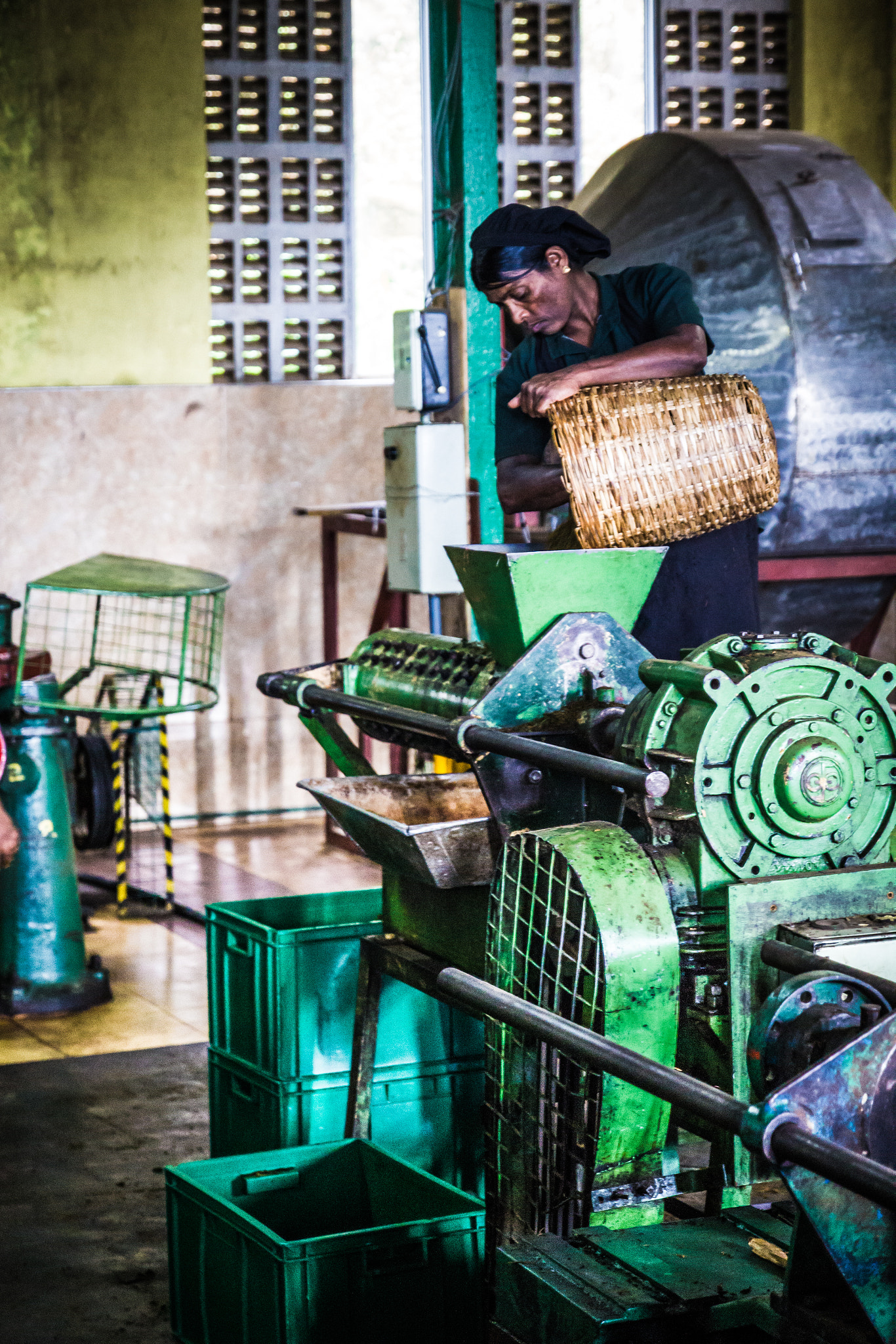
The orthodox tea factory of the Ceylon high country is a four-storey timber building organised around a single descending journey of the leaf. The leaf enters at the top, in the green state, in the early evening of the day it has been picked; it leaves at the bottom, as black tea, in the early hours of the next morning. Between those two moments — between half past five on a Tuesday evening and three o'clock on a Wednesday morning, in the factory I am describing here — the leaf is moved through four named operations: withering, rolling, oxidation, firing. Each operation has its own floor, its own crew, its own machinery, its own time-discipline. The factory, when it is working well, is a vertical conveyor.
The factory I am writing about
The factory is at Talawakelle, in the Dimbula. It was built in 1899 by the same Belgian–Glasgow engineering firm that built fourteen other orthodox factories in the Central Province between 1895 and 1910, and it has been in continuous production, on the same site, with substantially the same building, since the August of that year. The structure is hardwood — jak and ebony — on a granite plinth, with corrugated-iron roofing that has been replaced several times. The withering loft is on the fourth floor; the rolling room is on the third; the oxidation hall is on the second; the firing room is on the ground floor. A single staff staircase, on the west side of the building, runs from the ground floor to the loft. A leaf chute, on the east side, drops withered leaf from the loft to the rolling room. Beyond that, the leaf moves by hand-trolley.
The four o'clock start
The factory day, on a normal estate, begins at four o'clock in the afternoon, when the first lorries arrive from the fields. The plucking is finished at half past three; the leaf is weighed and tagged at the field shed; the lorries cover the kilometre or two from the field to the factory in fifteen minutes. The first lorry's leaf — the morning round, picked between seven and eleven — is the day's largest and goes onto the withering troughs first. The afternoon round, picked between twelve and three, arrives forty minutes later and is layered on top.
The withering loft has thirty-two troughs, each twenty-four metres long and one and a half metres wide, with a perforated metal mesh as the base. Beneath each trough is a long horizontal duct connected to a four-foot diameter centrifugal fan at the building's eastern end. The fans draw air through the mesh, up through the layered leaf, and out through the ridge ventilators in the roof. The withering time, on a normal day, is fourteen to eighteen hours. The air is unheated in dry weather and lightly warmed (to about thirty-two degrees) in the wet monsoon months.
The point of withering is to reduce the leaf's moisture content from the seventy-five to eighty per cent at which it leaves the bush to fifty-five to sixty per cent at which it can be rolled. The leaf has to be flexible enough to be twisted without breaking, but dry enough that the rolling fractures the cell walls rather than just bruising them. The withering supervisor walks the troughs every two hours through the night, takes a handful of leaf, twists it in his palm, checks it against the calibrated samples in his pocket book, and adjusts the fan speeds accordingly. His judgement is the principal piece of skilled labour in the factory.
Rolling — the third floor
At about ten the next morning the withered leaf is dropped, by gravity, through chutes to the rolling room on the third floor. The rolling room is the loudest room in the factory. It contains seven orthodox rollers — large cast-iron machines that look something like the dough-mixers of an industrial bakery, with a heavy upper plate that presses and rotates the leaf in a circular trough below. The rollers are belt-driven from a single line shaft along the room's ceiling, which is in turn driven by a small hydro turbine in the stream behind the factory.
The rolling has two purposes. First, it fractures the cell walls of the withered leaf, which releases the leaf's juices and starts the oxidation reaction; second, it twists and forms the leaf into the small wiry pieces that are the shape of an orthodox black tea. A rolling cycle is fifty minutes — twenty minutes light pressure, ten medium, twenty heavy — followed by a fifteen-minute rest. The roller is unloaded; the leaf is broken up by a roll-breaker (a small rotary sieve); the larger pieces go back to the roller for a second cycle; the smaller pieces — the ones that will become the higher grades — go down to the oxidation hall on the second floor.
Oxidation — the second floor
The oxidation hall is the heart of the factory. It is a long room, about forty metres by twelve, with twelve copper-lined trays running along its length. The trays are raised at waist height; the leaf is laid on them at a depth of about four centimetres; the room is kept cool (twenty-three to twenty-five degrees) and very humid (ninety per cent or higher) by water-fed evaporation pads on the eastern wall. Large overhead fans circulate the air without drying the leaf.
The oxidation reaction — the conversion of the leaf's polyphenols to theaflavins and thearubigins, which give black tea its colour, its astringency, and most of its character — takes between two and four hours depending on the leaf, the season, and the weather. The oxidation supervisor reads the leaf by colour, by smell, and by the sound it makes when he squeezes a handful (a fully oxidised leaf releases a distinctive coppery aroma and a slightly sticky moisture). When the leaf is at the right point — which is a judgement no machine has yet replicated — it is moved, by hand-trolley, down to the firing room on the ground floor.
Firing — the ground floor
The firing arrests the oxidation by driving the leaf's moisture content down from about forty-five per cent to three per cent in twenty-five minutes. The firing machine in this factory is a Britannia drier — a long horizontal box, six metres long, with a chain-conveyor running through it and a coal-fired heat exchanger at one end. The leaf enters at the cool end and exits at the hot end, having travelled the length of the conveyor in about twenty-three minutes at a chamber temperature that begins at ninety-five degrees and rises to a hundred and twenty.
The fired tea exits the drier as the black tea of commerce — small, wiry, dry, intensely aromatic, ready for sorting. The firing supervisor — almost always the most senior man on the floor — controls the conveyor speed and the firebox temperature by a combination of instinct and a small set of brass dial thermometers that have been on the same wall since 1948.
Sorting — the late evening
The sorting room is adjacent to the firing room and runs through the late evening and into the early hours. The fired tea is moved through a sequence of mesh sorters of decreasing aperture, which separate it into the grades that the Colombo auction will recognise: the leaf grades (OP, OPA, FOP, FBOP); the fanning and dust grades (PF, Dust 1, Dust 2); and the broken grades (BOP, BOPF). Each grade is weighed, bagged, labelled with the estate name and the grade, and stacked in the bonded store for collection by the broker's lorry the following morning.
By three in the morning the factory is quiet. The lights on the upper floors are off; the withering troughs are empty; the rollers are at rest; the oxidation hall is being washed down; the firing room is cool. The day-shift labour will arrive at half past five to begin loading the next day's leaf onto the troughs. The cycle is twenty-three hours from leaf-in to bag-out, and the factory completes that cycle, on a normal estate week, six days out of seven.
The orthodox factory is a building built to a single argument: that the leaf, moved through four named operations in a particular order at a particular pace, becomes a substance the bush itself does not contain. The factory is, in that sense, an argument in timber.
What the factory does well
Three things, in my reading.
First, the orthodox process — withering, rolling, oxidation, firing, in that order — produces a tea of much greater aromatic complexity than the rotorvane or CTC processes that have displaced it in much of the Indian and African tea industries. The cost is volume: an orthodox factory produces about half the throughput per unit of capital that a CTC factory does. The Ceylon high country, on the whole, has chosen quality over volume.
Second, the building itself is a marvel of late-Victorian industrial design. The four-storey gravity-fed layout, the line-shaft drive, the cross-ventilated withering loft, the copper-trayed oxidation hall — these are decisions made in 1895 that still, a hundred and thirty years later, produce a competitive product. The annual capital expenditure on this factory is about three per cent of its replacement cost; many CTC factories built in 1995 are already in their second major refit.
Third, the skilled-labour content of the orthodox factory — the withering supervisor, the rolling foreman, the oxidation supervisor, the firing man, the sorting supervisor — is substantially higher than in a CTC factory. The judgements those five men make in a normal twenty-three-hour cycle are not yet replicable by machine. The factory is, in the literal sense, made of their judgement.
What the factory does not do well
One thing. The throughput per worker is low, and the workers are ageing. The withering supervisor at this factory has been at the same post for thirty-one years; his probable retirement is within five years; his successor has not yet been identified. The same is true at four of the five skilled positions. The factory's capacity to reproduce its own skilled labour is, on present evidence, not assured.
Researched on visits to a Talawakelle orthodox factory between October 2024 and December 2025. The factory has asked not to be named in the journal. The technical descriptions are checked against the Tea Research Institute's Orthodox Manufacture Manual (Revised Edition, 2019).